3/4/2026
Walker Hosts Award-Winning Author On How to Navigate the College Process to Find the "Dream School"
|
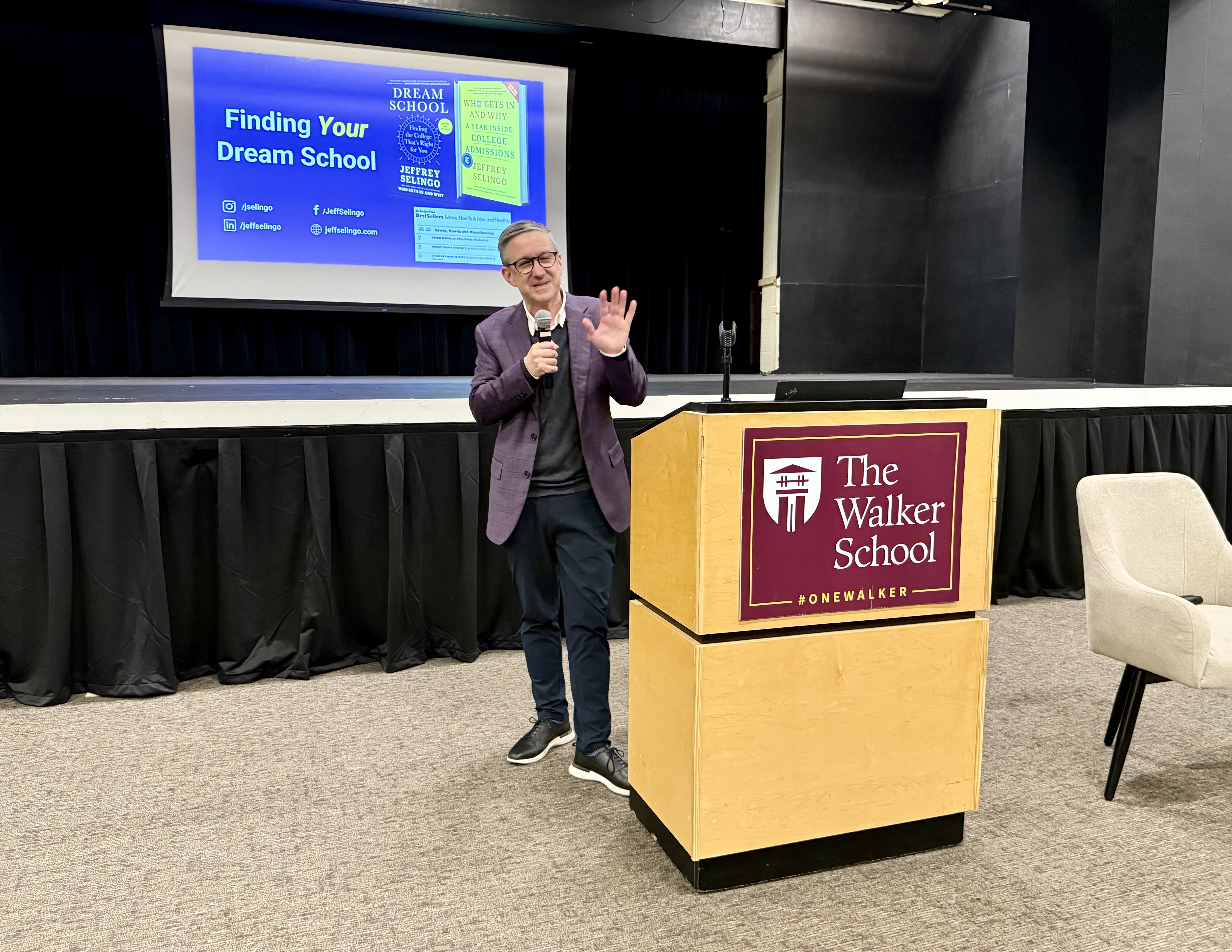
Families at The Walker School recently had the opportunity to hear from one of the nation’s leading voices on college admissions as author Jeffrey Selingo visited campus during his national tour for his new book, Dream School. Selingo, a New York Times best-selling author of Who Gets In and Why, has written about colleges and universities for more than 20 years. A former editor at The Chronicle of Higher Education, he has reported extensively on admissions trends and higher education for publications including The New York Times and The Wall Street Journal. At Walker, Selingo delivered a timely and candid message: Families need to widen their lens when defining a “dream school.” 3,000 Colleges and Counting“When I think about higher education, there are 3,000-plus colleges and universities,” Selingo told parents. “Even if we just talk about four-year colleges with at least 1,000 students, we’re still talking about a universe of about 1,200.” The question, he said, is not whether great colleges exist, it’s how to find the right one among those 1,200. Too often, families run to rankings for answers, he said. Decades ago, there was essentially one dominant ranking. Today, Selingo noted, “you can find a ranking about anything.” The problem? The schools at the top of most rankings look similar, and they’re also the hardest to get into. According to U.S. News & World Report data, the average acceptance rate among the top-ranked national universities hovers around 15 percent. That dynamic has fueled what Selingo calls “application inflation.” In 2001, nearly 4 million college applications were filed in the United States. By 2023, that number had ballooned to nearly 14 million, even though there were only about 800,000 fewer high school graduates in 2001 than today. Students are not applying because there are dramatically more seniors; they are applying to more colleges per student. “When I applied to college,” Selingo joked, “it was back in the days of the electric typewriter. I got tired after about three applications and was done.” For decades, that was typical. Today, students often apply to 10, 12, even 15 schools. The result? The same highly selective institutions appear on list after list, year after year. Applications to many elite colleges have tripled since 2001. Acceptance rates drop, uncertainty rises, and families feel compelled to apply to even more schools. But acceptance rates, Selingo emphasized, “tells you nothing about the quality of a college or university and nothing about the fit for your child.” Why Selectivity Can Be MisleadingSelingo explained another little-understood metric: yield, the percentage of admitted students who enroll. In 2001, schools like Duke University, Brandeis University, George Washington University and Syracuse University had similar yield rates of around 40 percent. Two decades later, Duke’s yield has climbed to roughly 60 percent, while the others have fallen below 20 percent, Selinga said. As students apply to more schools, institutions must compete harder to be “the one.” Colleges with rising yields can admit fewer students and appear more selective. Schools with declining yields must admit more students to fill their classes, making their acceptance rates rise, even if academic quality hasn’t changed at all. “What ends up happening,” Selingo said, “is parents see those higher acceptance rates and think something must have happened to that school. But it’s really about application volume.” What Actually Signals Fit?If acceptance rates and rankings don’t tell the whole story, what does? Selingo pointed to data from the National Survey of Student Engagement, which has surveyed students at 1,400 colleges and universities for more than 20 years. The top indicators of a positive college experience consistently center on engagement:
When Selingo analyzed senior-year data for Dream School, he found something surprising: overall student satisfaction overlapped significantly across the selectivity ladder. Students at less selective colleges reported levels of satisfaction comparable to those at the most elite institutions. In some measures, including student-faculty interaction, colleges with acceptance rates between 20 and 40 percent actually outperformed the most selective schools. He shared the story of William, a high-achieving student from Minnesota who applied Early Decision to Columbia University because of its prestige. After enrolling, he struggled to access classes, research opportunities and clubs due to competition. By winter break, he wanted to transfer. He eventually moved to the University of Minnesota, where he found mentors, conducted research and felt at home. “I was enamored by the selectivity,” William later admitted. Selingo said he heard similar stories repeatedly while reporting the book. Outcomes Across the SpectrumIn Dream School, Selingo highlights 75 institutions, all with acceptance rates of at least 20 percent, that demonstrate strong student engagement, return on investment, job placement and geographic diversity. He shared the story of Emily, a Pennsylvania student who chose the University of Mississippi over Rice University after earning a full scholarship and acceptance into the honors college. Debt-free and supported with undergraduate research and study abroad stipends, she later earned a Fulbright scholarship to Germany. When surrounded by peers from highly selective colleges, she found herself on equal footing but without student loans. Harvard Law School’s entering class each year, Selingo noted, includes graduates from Ivy League institutions but also from large public universities and small liberal arts colleges, many of which families would not immediately recognize. “Students up and down the selectivity ladder end up working at Fortune 50 companies,” he said. “Outcomes are not limited to the top of the rankings.” Financial Fit MattersToday, some private colleges approach $90,000 per year in total cost. Financial fit, Selingo urged, must be part of the conversation early. “Run the net-price calculator,” he advised, referring to the federally required tool on every college website. “Approach this like any other major purchase like a house or a car.” He encouraged families to avoid falling in love with a campus before understanding its price tag. Colleges, he said, are skilled at tugging emotional heartstrings before financial realities are clear. Large public universities and smaller private colleges offering significant merit aid often provide strong honors programs, undergraduate research access and generous scholarships. “That doesn’t make them worse schools,” Selingo said. “It just means we need to broaden our lens.” A Healthier ProcessSelingo also addressed the growing pressure around Early Decision, noting that some colleges now fill 50 percent or more of their classes through binding early programs. While ED can benefit students certain of their choice, it often limits the ability to compare financial aid offers. He encouraged families to build balanced lists: a mix of reach, target and foundational schools and to genuinely like at least one of each area. “Families who are happiest at the end of this process,” he said, “are the ones with balanced lists.” He urged parents to give students permission to enjoy high school, explore interests authentically, and resist constant comparisons within their community. “We talk about college more than we should,” he said. “Until senior year, maybe talk about it once a week at most.” Above all, he encouraged authenticity in applications. Essays, he noted, should reflect the voice of an 18-year-old, not a polished adult. Admissions officers spend only minutes reading each file. A strong essay helps reveal character, but it rarely singlehandedly determines admission. Finding a College That Loves You BackSelingo closed by reframing the concept of a dream school. Instead of chasing a name, families should look for:
“Eventually, you will find your dream school,” he said. |
|
EXPLORE MORE
HEADLINES

Walker’s Tulowitzky Named Region Athletic Director of the Year

Walker School Alum Harrison Awarded Fulbright to Teach in Spain

Acclaimed Poet Gabrielle Calvocoressi Visits The Walker School